
ExcelliPrint Security
ExcelliPrint® 5.0 is a Windows program and a Windows service, with nothing for a browser to reach.
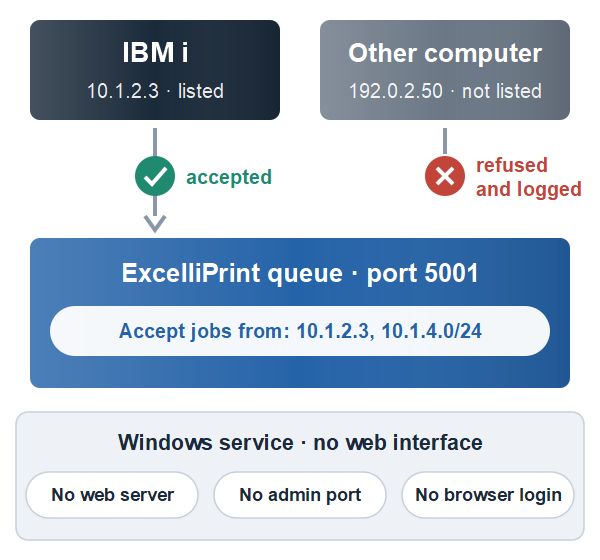
No web interface
Earlier versions were administered through a built-in web server. Version 5.0 has none: there is no web server, browser login or SSL certificate to manage, and no administration port to open. Queues, jobs and the log are in the ExcelliPrint window on the computer where it runs.
Jobs only from your hosts
IPDS has no login, so anyone who can reach a printer’s port could send it jobs. Each ExcelliPrint queue therefore takes jobs only from the hosts in its Accept jobs from list: IPv4 addresses such as 10.1.2.3, and ranges such as 10.1.4.0/24. The list is required; a queue never accepts every host by default. A connection from any other address is closed before anything is read, and logged with the address.
Host names aren’t accepted, so a forged name lookup can’t let another computer in. For a second layer, setup’s Windows Firewall rule can be limited to your hosts’ addresses too.
Only administrators change settings
Anyone signed in to the computer can open ExcelliPrint and view queues, jobs and the log. Changing anything (queues, stored users, the font map, restoring a backup) needs a Windows administrator; the window’s title says whether you can make changes or are viewing only.
Passwords protected by Windows
ExcelliPrint stores the passwords it needs, for network shares, shared printers, the mail server and PDF files, encrypted with Windows’ data protection for that computer. They can’t be read on another computer or from a copy of the database; restoring a backup on a new computer asks for them again.
Runs as a Windows service
The service receives print jobs without requiring a Windows user to be logged in, and runs under its own service account rather than as a user. To reach a network share or a shared printer, it connects as a Windows user you store for that queue, instead of impersonating anyone.
Email over TLS
Jobs sent by email use an encrypted connection to the mail server by default; a server that can’t encrypt is refused unless you turn that off for an internal relay.
Captures under your control
For troubleshooting, queues can save the data the host sends. Captures and diagnostic logs are kept in a folder only administrators can read, are deleted with the job history after a few days, and can be turned off for any queue whose jobs shouldn’t be kept in another form.